
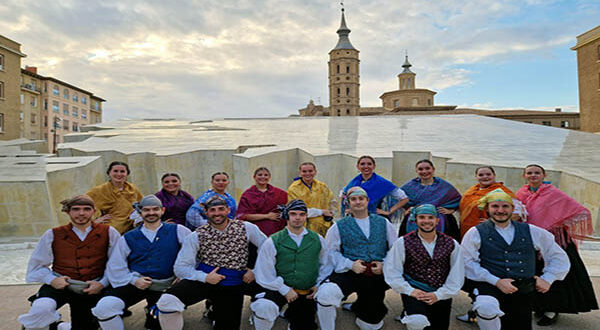
The Aragonese regional costume is much more than folkloric clothing. It is living memory, cultural identity, and a symbol of a land that breathes history, devotion, and customs passed down from generation to generation. Aragón cannot be understood without its dances, its jota, the strength of its people… and neither without its typical costume, which has accompanied peasants and shepherds as well as the faithful during the Fiestas del Pilar, when the Virgin receives every year an immense floral mantle framed by thousands of colors, fabrics, and scarves.
In this article we will dive into the richness of the Aragonese regional costume, exploring its history, its most characteristic elements, its little-known curiosities and, above all, its spiritual and cultural dimension as an expression of a people deeply united to the Virgin of El Pilar and the Catholic faith.
Origins of the Aragonese Regional Costume
The Aragonese costume has its roots in the 18th and 19th centuries, when popular clothing reflected both social class and geographical origin. Shepherds, farmers, artisans, and merchants dressed differently, but all shared certain common features: sturdy fabrics for work, sober colors for everyday life, and more ornamental details on festive days.
Over time, these everyday garments were refined and transformed into symbols of cultural identity, especially when the jota — Aragón’s quintessential song and dance — began to gain prominence in the 19th century. Dancers needed clothing that, in addition to being functional, would be representative and eye-catching. Thus was born what we know today as the Aragonese regional costume.
Interestingly, the costume was not the product of folkloric “invention,” but rather the natural evolution of peasant and urban clothing. What we see in today’s festivities has behind it centuries of textile tradition, rural customs, and social adaptations.
The Female Costume: Elegance, Strength and Color
The woman’s Aragonese costume is unmistakably beautiful. It stands out for its sober elegance, yet is full of details that speak of history and tradition.
- The skirt or “saya”: wide, usually made of wool in winter or cotton in summer, with vivid colors such as red, blue, or green. Many are striped or floral patterned.
- The “refajo”: an underskirt that provides volume and warmth.
- The apron: not only functional but also decorative, often with handcrafted embroidery that makes each piece unique.
- The mantilla or shawl: perhaps the most striking element. They may be made of embroidered wool, silk, or velvet, many with long fringes that move with the dance of the jota.
- The blouse or shirt: usually white, with lace or trimming on the sleeves.
- The hairstyle: hair gathered in traditional buns, often adorned with combs.
The ensemble conveys strength, femininity, and pride. It is no coincidence that, during the Flower Offering to the Virgin of El Pilar, thousands of Aragonese women wear these costumes to honor the Mother of God, clothing not only their bodies but also their faith.
The Male Costume: Sobriety and Character
The male regional costume reflects the ruggedness and nobility of the Aragonese man. Although at first glance it may seem simpler than the female version, it is full of personality.
- The sash: an essential piece, long and brightly colored, wrapped around the waist to hold the trousers.
- The breeches or “zaragüell”: wide trousers that reach the knee, generally made of linen or cotton.
- The shirt: white, of linen or cotton, sometimes decorated with ruffles.
- The vest: embroidered or made of velvet, with metallic buttons.
- The “cachirulo”: the red-and-black checkered scarf tied around the head. This is perhaps the most recognizable symbol of the Aragonese costume and of Aragonese identity itself.
- The cloak or long sash: used in winter or on solemn occasions.
The man dressed as a baturro embodies the figure of the Aragonese peasant: strong and hardworking, yet also devout and proud of his land.
The Costume and the Aragonese Jota
One cannot speak of the costume without speaking of the jota, the dance and song that best represents the Aragonese soul. At every festival, the swirl of skirts and the flutter of shawls, along with the elegance of vests and sashes, make the costume a visual protagonist of the music.
The jota, which was born as a popular song in squares and fields, found in the regional costume its perfect companion. The clothing not only adorns but also highlights the expressiveness of the dance: fringes that fly, colors that blend, the scarf waved with force… Everything contributes to making each jota also a showcase of textile culture.
The Regional Costume in the Fiestas del Pilar
The peak moment in which the Aragonese regional costume shines most brightly is during the Fiestas del Pilar, every October in Zaragoza.
The Flower Offering to the Virgin of El Pilar is a unique event in the world: thousands of people, from all corners of Aragón and abroad, dress in the typical costume to place flowers at the feet of the Virgin. The Plaza del Pilar becomes a human mosaic of colors, scents, and faith.
At that moment, the costume ceases to be just folklore and becomes an act of devotion. Each flower, each scarf, each embroidered shawl is an expression of love for the Virgin. The regional costume then becomes prayer made fabric.
Little-Known Curiosities About the Aragonese Costume
- The “cachirulo” was not always red and black: although today it is the most popular, there used to be scarves of many colors and patterns, depending on the region and the occasion.
- The embroidery was a “secret language”: some families stitched symbols or initials into aprons and shawls as a sign of identity.
- Festive costumes were inherited: they were valuable, handmade pieces passed down from mothers to daughters or fathers to sons as true family treasures.
- The Mudéjar influence: some textile designs resemble Aragonese Mudéjar art, with geometries and colors that evoke that cultural fusion.
- There was not just one regional costume: depending on the region (Huesca, Teruel, Zaragoza), there were variations in colors, cuts, and adornments.
The Aragonese Regional Costume Today: Identity and Pride
Far from being relegated to the past, the Aragonese costume remains alive and thriving. Cultural associations, folkloric groups, and brotherhoods keep it present in festivals, pilgrimages, and processions.
Today, many young people wear it proudly during the Offering of Flowers, feeling that by putting on the costume they connect with their family history and with the faith of their ancestors. The regional costume thus becomes a bridge between generations, where grandparents, parents, and grandchildren share tradition and devotion.
Moreover, Aragonese clothing has crossed borders. In Latin American cities such as Buenos Aires or Mexico City, Aragonese communities also celebrate the Offering and wear the traditional costume, keeping alive the flame of their identity far from home.
A Costume that Speaks of Faith
Beyond the cultural, the Aragonese regional costume holds a spiritual meaning. Wearing it in honor of the Virgin of El Pilar is a gesture of love and belonging. It is saying to the Mother of God: “Here we are, with what we are, with our roots, our families, our people.”
Each tied scarf, each unfurled shawl, each flower deposited is part of a popular liturgy that turns the streets into a temple and tradition into prayer.
That is why the Aragonese regional costume is not just folklore. It is culture, history, identity, and faith. It is Aragón woven into fabric, music, and devotion.
Conclusion
The Aragonese regional costume is a cultural jewel that continues to beat in every festival, in every jota, and above all, in every Offering to the Virgin of El Pilar. Its colors, its shapes, and its history speak to us of a people proud of their roots and deeply devoted to their Patroness.
Those who dress in the Aragonese costume not only honor their ancestors: they also express an indestructible bond with their land and with their faith. Because in Aragón, culture and religion walk hand in hand, and the regional costume is the visible testimony that traditions, when lived with love, never die.
