
Related Articles
Visiting the Basilica of Our Lady of the Pillar in Zaragoza is not simply stepping into a temple. It is, in reality, entering a universe of art, faith, and culture that has pulsed for centuries to the rhythm of Marian devotion. Beneath its domes intertwine the prayers of pilgrims, the echoes of Aragón’s history, and the grandeur of an artistic style that sought to embody in stone and plaster the most sublime of human experiences: the encounter with God.
In this article I invite you to take a different journey: to decipher the Baroque that gives form to the Basilica and to understand how its architecture is not mere decoration, but a visual and spiritual language that pays homage to Our Lady of the Pillar, patroness of Aragón and of all Hispanic peoples.
The Baroque: an art that speaks to the heart
To understand the architecture of the Basilica of the Pillar, we must first place ourselves in the 17th and 18th centuries, when Europe vibrated with an exuberant artistic style: the Baroque.
Unlike the Renaissance, which sought harmony and balance, the Baroque was an art that aimed to stir, move, and touch the soul. It was born in the context of the Counter-Reformation, when the Catholic Church sought an art form that could speak directly to the people, that left no one indifferent, and that transformed the spiritual into something tangible.
The Baroque is drama, light and shadow, movement, grandeur. But above all, it is an art that is didactic and devotional: every twisted column, every painted dome, every play of light has a purpose—and that purpose is to lead the faithful toward the contemplation of the divine.
The Basilica of the Pillar: the Baroque home of the Virgin
Tradition tells us that in the year 40 A.D., the Virgin Mary, still alive on earth, appeared to the Apostle James on the banks of the River Ebro to encourage him in his mission of evangelization. As proof she left a jasper column—the “pillar”—upon which a humble chapel was built.
Over the centuries, that chapel grew into a Romanesque temple, then a Gothic church, until finally, in the height of the Baroque era, the majestic Basilica of the Pillar that we know today was erected. Construction began in the 17th century and was not completed until the 18th, with contributions from great architects such as Felipe Sánchez, Francisco Herrera the Younger, and Ventura Rodríguez.
What makes it special is that it is not an overloaded or oppressive Baroque, but rather a Spanish Baroque, with distinctive Aragonese traits: monumental, luminous, and solemn.
The emotion of space: domes that lift the soul
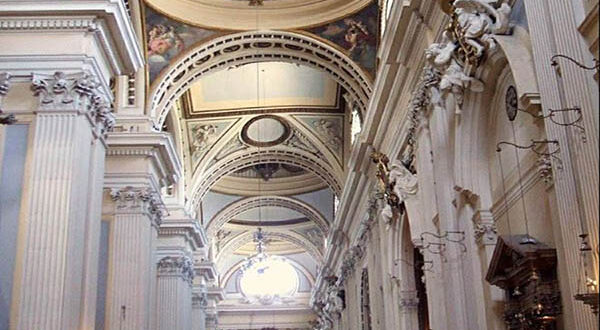
One of the Baroque’s greatest languages is the dome, and in the Basilica of the Pillar we find a masterful display. The eleven domes and four towers draw the unmistakable silhouette of the temple against the Zaragoza skyline.
Inside, the domes serve not only a structural purpose, but also a symbolic one. They are like open heavens inviting the faithful to lift their gaze. Many are decorated with frescoes by artists such as Francisco de Goya, whose brushstrokes in the Coreto dome and the Regina Martyrum still today move visitors with their force and expressiveness.
Each dome is a reminder that faith is not confinement but openness, and that Our Lady of the Pillar welcomes all her children under her mantle.
Light and devotion: a sensory journey
The Baroque plays with light as a painter does with a palette. In the Basilica of the Pillar, the natural light streaming through the windows caresses the walls and the altar, creating contrasts that seem like a heavenly spectacle.
But the Baroque architecture of the Pillar also considered inner light: the golden gleam of the altarpieces, the candles that burn unceasingly, the radiance surrounding the Holy Column. Everything in the temple is designed to generate an atmosphere of reverence and wonder.
A little-known curiosity: the Virgin’s camarín (shrine), where pilgrims may approach to kiss the Pillar, is itself a Baroque jewel. It was designed as an intimate, almost theatrical space, where the pilgrim experiences closeness with the Virgin, culminating the visual and spiritual journey that begins upon entering the temple.
The main altarpiece: catechesis in stone and gold
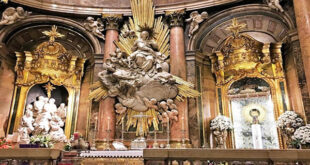
One of the most striking elements of the Baroque is the main altarpiece, the work of Damián Forment in the 16th century, which although Renaissance in style, was perfectly integrated into the Baroque spirit of the temple.
The altarpiece narrates scenes from the life of the Virgin and Christ with a level of detail that still astonishes today. At a time when most of the people could not read, the altarpiece functioned as a Bible in images, catechizing through art.
The Baroque sought to teach through beauty, and in the Basilica of the Pillar this mission is fulfilled abundantly.
The devotional purpose: architecture that becomes prayer
Beyond technique, design, and monumentality, the Baroque architecture of the Pillar has a clear intention: to be an instrument of devotion.
Every arch, every dome, every altar is designed not merely for contemplation but for prayer. It is a space that becomes an extension of the prayer of the Aragonese people to their Mother of the Pillar.
The Baroque of the Pillar does not seek cold aesthetic admiration, but spiritual experience. And that is why, even today, the temple is alive: filled with Masses, pilgrimages, confessions, hymns, and silence.
Little-known curiosities
- The bombs that did not explode: During the Spanish Civil War, three bombs fell on the Basilica. None of them exploded. Today they are preserved in the sacristy, interpreted by many faithful as a sign of the Virgin’s protection.
- The smallest Virgin: The image of Our Lady of the Pillar measures barely 36 centimeters, and yet her presence has inspired entire cathedrals and the fervor of millions of devotees.
- Goya, devotee and artist: The great Aragonese painter left part of his genius in the Pillar. His frescoes, in a style closer to Rococo, marked a turning point in Baroque pictorial tradition.
Our Lady of the Pillar: spiritual heart of Aragón and Hispanic America
All this Baroque splendor would have no meaning without Her: Our Lady of the Pillar. Her presence makes the Basilica something more than a temple. She is a symbol of Aragonese identity, a beacon of faith for Spain, and a spiritual bond with Hispanic America, where millions of devotees celebrate her feast every October 12.
The Baroque sought to make the invisible visible, and at the Pillar it succeeded: surrounding the Virgin with an architecture that not only guards her but also magnifies her as Mother, Queen, and Protector.
Conclusion: a journey that transforms
To decipher the Baroque of the Basilica of the Pillar is to discover that architecture can be a catechesis in stone and light. It is to feel that art, when born of faith, not only decorates but guides, inspires, and converts.
The journey into the heart of the Baroque offered by the Pillar is not only a cultural walk, but also a spiritual one. There, among domes, frescoes, and altarpieces, beats the devotion of an entire people who, century after century, continue to come and kneel before the Virgin—the same who, according to tradition, encouraged the Apostle James and who today accompanies everyone who crosses the threshold of her Basilica.
Because in the end, the greatness of the Baroque in the Pillar lies not only in its forms but in its message: God draws near, and the Virgin, from her Pillar, remains a firm column of our faith.
