
Related Articles
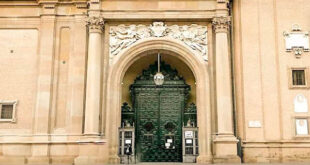
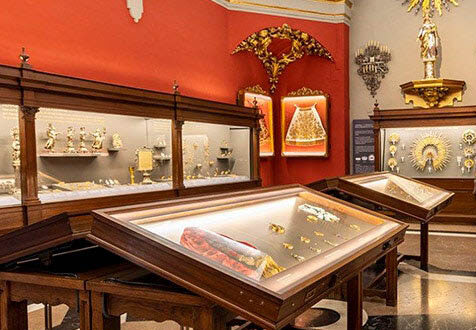
When you set foot in Zaragoza’s Plaza del Pilar, your eyes inevitably rise towards the majestic towers and domes of the Basilica of Our Lady of the Pillar. There, among Goya’s frescoes, chapels filled with history, and living devotion, lies a space little known to the general public but of immense artistic, cultural, and spiritual value: the Pilarista Museum. A place where faith and art come together to tell the story of centuries of devotion to the Virgin of the Pillar and, at the same time, narrate the history of Aragon and Spain through relics, liturgical pieces, and works of incalculable value.
In this article, I will guide you through this very special museum: what you will find in it, the curiosities it hides, and why it deserves to become an essential visit if you want to fully discover not only the Basilica, but also the very soul of the Aragonese people.
A Museum Born of Devotion
The Pilarista Museum was inaugurated in 1979 with a clear objective: to gather and exhibit to the public the artistic and liturgical treasures that the Basilica of the Pillar has safeguarded for centuries. Devotion to the Virgin of the Pillar, considered by tradition to be the first Marian apparition in history (to the Apostle James in the year 40), has not only inspired the construction of one of the most emblematic temples of Christendom, but also an immense cultural heritage.
Every jewel, embroidery, sculpture, or document that we contemplate today in the museum was born out of the faith and love of entire generations. Kings, nobles, popes, humble pilgrims, and great artists alike wanted to leave their mark around the Virgin. The museum thus becomes a mirror of the history of Spain and of popular religiosity.
What to See in the Pilarista Museum
The tour of the museum is much more than a simple walk among showcases: it is a true lesson in history, art, and spirituality.
1. The Crowns of the Virgin of the Pillar
Undoubtedly one of the most admired treasures in the museum. Since the 17th century, the Virgin of the Pillar has received numerous crowns of gold, silver, and precious stones as offerings from kings, queens, and faithful. The most famous is the Crown of Hispanicity, crafted in 1904 with gold and gemstones donated by the countries of Latin America, as a symbol of spiritual unity around the Virgin.
These crowns are not mere luxury items: they are symbols of love and gratitude, expressions of a bond that transcends borders.
2. The Mantle of the Virgin
Another fundamental piece is the mantle of the Virgin, of which the museum preserves examples from different eras and styles. Every day, the Virgin of the Pillar wears a different mantle, and this daily gesture has centuries of history. There are mantles embroidered with gold threads, silk, delicate lace, and others more modest, all of them offered as tokens of devotion.
One of the most moving is the mantle of the bullfighters, donated in 1908 by the Union of Bullfighters after the anarchist attack on King Alfonso XIII in Madrid. Also remarkable are the mantles gifted by humble families, lovingly sewn with great sacrifice.
3. Liturgical Ornaments and Relics
The museum exhibits chalices, monstrances, ciboria, processional crosses, and liturgical vestments that have been used in the Basilica’s great celebrations. Each object speaks to the solemnity with which the Church has honored the Virgin and the Blessed Sacrament.
An interesting highlight is the gilded silver monstrance from the 18th century, used in Corpus Christi processions, as well as chalices donated by different monarchs.
4. Historical Documents
The Pilarista Museum preserves documents and manuscripts that allow us to reconstruct the history of the Basilica and its worship. Notable among them are papal bulls confirming privileges granted to the temple, as well as engravings and plans of the various phases of construction.
Among these documents we find graphic evidence of how the appearance of the Pillar has changed throughout the centuries, from the original Mudejar chapel to the current baroque basilica.
5. Paintings and Sculptures
The museum also houses canvases, sculptures, and engravings that reflect Marian devotion. Many of them are works by local artists depicting scenes linked to the miracle of the Pillar or to historical episodes of the city.
A very special piece is a baroque wooden polychrome carving of the Virgin, representing how she was venerated before the current form of the Holy Column.
Little-Known Curiosities of the Museum
- The oldest jewel: Among the oldest pieces in the museum is a Gothic chalice from the 15th century, a witness to medieval devotion.
- The traveling mantle: Some mantles on display have accompanied the Virgin on historic journeys, such as the transfer to Madrid in 1904 for the canonical coronation.
- A symbol of Aragonese identity: The museum also preserves popular offerings, such as flags, military insignia, and plaques, showing how the Virgin of the Pillar has always been a banner of faith and Aragonese identity.
The Cultural and Spiritual Value of the Pilarista Museum
Visiting this museum is not just about gazing at artistic pieces. It is about entering the heart of a people and their history. Every object has a spiritual background: it expresses the living relationship between the Virgin and her devotees.
For the people of Zaragoza, and for Aragonese in general, the Virgin of the Pillar is not a mere religious symbol, but a profound bond with their roots, their land, and their history. By preserving these pieces, the Pilarista Museum becomes a guardian of collective memory.
An Essential Visit in Zaragoza
If you are planning to travel to Zaragoza, do not limit yourself to walking through the Basilica’s naves and gazing at the Holy Column. Take some time to enter the Pilarista Museum and let yourself be surprised.
- Where it is: The museum is located inside the Basilica, with access from the temple itself.
- Opening hours and entry: Admission is usually included in the tourist visit to the Pillar, and the schedule follows that of the Basilica. It is advisable to check them beforehand.
- Duration of the visit: You can tour it in less than an hour, but if you are a lover of art and history, we recommend dedicating more time to appreciate each detail.
The Pilarista Museum in the Digital Age
Today, with the expansion of digital culture, the Pilarista Museum is also looking to the future. Some of its pieces have been digitized and appear in online catalogs, allowing researchers and devotees worldwide to better discover this heritage. However, nothing can replace the emotion of seeing up close a crown, a mantle, or a chalice that has witnessed centuries of devotion.
Conclusion: A Space that Beats with History and Faith
The Pilarista Museum is not just a museum: it is an extension of the soul of the Pillar. In its showcases and rooms we do not find cold objects, but living testimonies of the faith of generations who have loved the Virgin.
There shines the brilliance of gold and silver, but also the invisible glow of popular devotion, of prayers, of tears, and of the hopes that millions of faithful have placed over the centuries.
That is why, for those who enter this museum, it is not just about learning history: it is about encountering the force of a tradition that remains alive. An essential corner to understand the Basilica, Zaragoza, Aragon, and ultimately, the very heart of Catholic faith in Spain.
