
Related Articles
There are places in the world where stones speak, where history can be breathed in, and where faith has its own soundtrack. In Zaragoza, in the very heart of the city bathed by the Ebro, there exists a sound that sets the rhythm of the days, a hymn that rises from the depths of the Basilica of El Pilar and intertwines with the heartbeat of thousands. It is not just a melody; it is a collective sigh, a cry of faith and identity. It is the moment when, as punctual as the sun, the entire temple fills with the solemn yet jubilant notes of ‘Bendita y Alabada’.
But why this song, and not another, has the honor of sounding every day? What secrets does this tradition hold that calls even the most secular to pause and look upward? The answer is a fascinating journey that navigates the rivers of history, theology, Aragonese culture, and a devotion that has shaped a kingdom. And to understand it, we must begin with a powerful and meaningful word: aspiration (jaculatoria).
It’s Not Just a Hymn: It’s an Aspiration, a Dart Shot Toward Heaven
In the richness of Catholic spirituality, an aspiration (jaculatoria) is a short, fervent, and spontaneous prayer, launched toward heaven like a dart of love and praise. It is a cry of the soul in moments of joy, pain, or need. ‘Bendita y Alabada’ is, in its purest essence, the Marian aspiration par excellence of Aragon.
Its lyrics, “Blessed and praised be the hour in which the Most Holy Mary came in mortal flesh to Zaragoza”, concentrate a monumental faith into a single line. It is not a verse from a long poem; it is a quick, intense, and direct act of devotion. This characteristic of being an aspiration explains its power and its ease of being memorized and recited by children and the elderly, by believers and by those who, without being practicing, feel the flame of cultural identity. It is the pious dart that connects the heart of the devotee with the mystery of the Virgin’s Coming.
The Origin of the Aspiration: The Miracle of the Coming
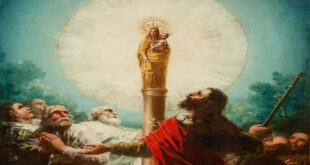
To find the germ of this praise, we must go back to the year 40 AD. James the Greater, one of the apostles of Jesus, was preaching in Roman Hispania, then a land of pagans, feeling failed and discouraged. It was on the banks of the Ebro River where, according to tradition, the Virgin Mary appeared to him atop a pillar of jasper (el Pilar), still in her earthly life, to comfort him and entrust him with the construction of a chapel on that very spot.
That instant, that “hour” to which the aspiration refers, is the fundamental pillar of faith in Aragon and one of the most venerated tenets of the Church in Spain. The song ‘Bendita y Alabada’ is the musical and collective commemoration of that aspiration which, for centuries, the faithful have recited in a low voice when passing by the Holy Chapel. It is the way of saying, generation after generation: “We remember. We believe. We are in awe.”
The Bell That Calls to Collective Aspiration: “La Benditera”
Before modern sound systems existed, it was a bell tasked with summoning the faithful to this communal prayer. In the northwest tower of the Basilica, next to the Holy Chapel, there is a medium-sized bell of immense significance: the bell “Benditera” or “de la Oración” (of Prayer).
Its peal, different from the bells that mark the hours or call to Mass, was the one designated to invite the faithful inside and outside the temple to recite the Salve and, of course, the aspiration “Bendita y Alabada.” Its sound was a reminder that cut through the city’s daily routine. The merchant would stop counting his coins, the woman would interrupt her housework, the child would stop playing. Everyone, wherever they were, would cross themselves and recite the aspiration. It was the sound of faith interrupting the secular world to elevate it to the divine, uniting the community in a single, brief, and powerful voice.
Today, although the manual ringing of the Benditera is less frequent, its spirit endures. The hymn now played through the speakers is the technological evolution of that bell, keeping its primary mission alive: to summon the aspiration of praise collectively.
How Many Times Does It Sound a Day? The Rhythm of Devotion
This is one of the most common questions among visitors. The musical aspiration ‘Bendita y Alabada’ does not sound randomly. Its repetition marks the key moments of the day in the sanctuary, creating a ritual cadence that orders sacred time.
It is heard four times a day, coinciding with the most important acts of devotion:
- In the morning (around 8:00 a.m.): With the recitation of the Morning Prayer. It is the first “dart” of praise of the day, a way to consecrate the coming hours to the Virgin’s protection.
- At noon (at 12:00 p.m. sharp): A magical moment. The sun is high and the Basilica is usually full of visitors. The sound of the hymn causes an instant and palpable pause. Hundreds of people, without any prior agreement, stop talking, walking, taking photos. Many cross themselves, others recite the aspiration in a low voice, and more than a few feel their skin tingling with emotion. It is a powerful demonstration of collective faith through this short prayer.
- In the afternoon (around 6:00 p.m., varies by season): With the recitation of the Holy Rosary. It is a call to reflection and meditation in the final stretch of the day, crowned by the aspiration.
- In the evening (at 8:00 p.m. sharp): With the singing of the Salve Regina before the main altar. It is the farewell of the day, the final act of love and praise to the Virgin before the temple closes its doors. For many, it is the most emotional and solemn moment to recite this prayer.
These four occasions are not an arbitrary number. In Catholic symbolism, the number four represents the earthly, the cardinal points, the evangelists… It is a number of universality. Thus, the aspiration extends to the four corners of the world from the heart of Zaragoza, at the four pivotal moments of the devotional day.
A Little-Known Curiosity: The Legend of the Angels
There is a beautiful and little-known legend that circulates among the oldest devotees. It is said that the melody of ‘Bendita y Alabada’ was not composed by a human, but was heard by a deaf monk who was praying fervently before the Holy Chapel. In his worldly silence, God allowed him to “hear with his soul” the music that the angels sang unceasingly around the Virgin’s Pillar, a perpetual aspiration. Upon coming out of his ecstasy, the monk, miraculously, was able to hum the melody to the basilica’s musicians, who transcribed it so that everyone could join their voices to the celestial choir.
Although it is a legend, its beauty lies in what it conveys: the idea that this aspiration transcends the human, that it is of divine origin, and that when we sing it, we are joining an eternal symphony.
The Aspiration of a People: Beyond Religion
‘Bendita y Alabada’ has transcended its purely religious character to become a symbol of Aragonese identity. It is sung at pilgrimages, at the Pilar festivities (where millions of voices intone it during the Offering of Flowers), in grandparents’ homes, and at family celebrations. For the Aragonese, whatever their degree of religious practice, this melody and its text evoke homeland, belonging, and pride.
It is the sound of the land. It is the aspiration that summarizes the history of Aragon, a kingdom forged with a spirit of struggle and an unshakable faith that has always had the Virgin of the Pillar as its standard and protector. It is impossible to separate Aragonese culture from its Pilarist devotion, and ‘Bendita y Alabada’ is the ultimate expression of that indissoluble union.
Conclusion: When the Aspiration Sounds
The next time you walk through the Plaza del Pilar and the clock strikes twelve noon or eight in the evening, stop. Wait. Let the hustle and bustle of the city fade away for a moment. When the first notes of ‘Bendita y Alabada’ begin to flow from the basilica, close your eyes and truly listen.
Do not just listen to a melody. Listen to a two-thousand-year-old aspiration. Listen to the faith of countless generations launching their dart of love toward heaven. Listen to the legend of James and the Coming of the Virgin. Listen to the peal of the Benditera bell calling the faithful. Feel the identity of an entire people, strong, noble, and stubborn like their land. In that instant, you will not be a mere spectator; you will be part of a golden chain of faith and culture that connects the past with the present, the human with the divine, the earth with heaven.
‘Bendita y Alabada’ is, in short, the aspiration that is the heartbeat of El Pilar. And, by extension, the heartbeat of the soul of Aragon.
