
Related Articles
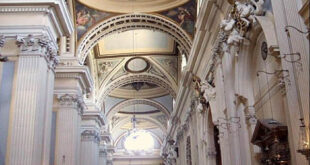
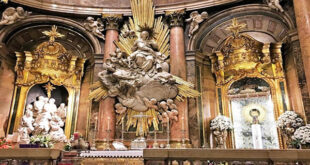
The Basilica of El Pilar as we know it today, an emblem of faith and an architectural masterpiece, did not emerge overnight. Its history is a journey of twenty centuries, an epic of stone and devotion that began with the most humble of structures and culminated in the baroque splendor that amazes the world.
The origins are lost in the mists of time, supported more by probable indications than by irrefutable data. Tradition speaks of a small chapel, an oratory dedicated to Santiago, erected by the first Christians next to the Ebro River. This narrow sacred space, a silent witness to the Coming of the Virgin, was the seed of everything to come.
As the centuries passed, faith needed more room. In the 2nd century, the primitive chapel was enlarged, and after the Edict of Milan in 313, which granted peace to the Church, it was transformed into a temple capable of housing a more solemn worship. Even under Arab rule, the sacred aedicula—as chroniclers called it—seems to have been respected, a small beacon of faith in a predominantly Muslim city.
The Light of the Reconquest and the First Major Works
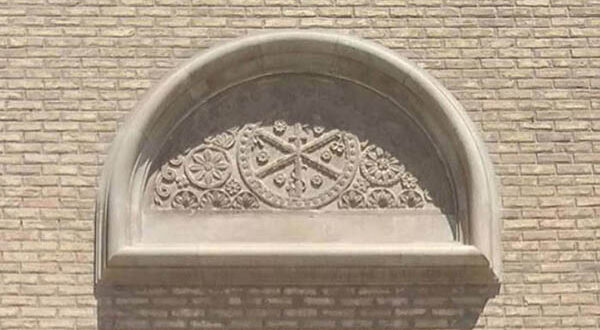
The reconquest of Zaragoza in 1118 ushered in a new era for the temple. It is from this moment that its history leaves the shadows and enters an “zone of light.” Bishop Pedro de Librana undertook the reconstruction of the old church in 1120, giving it Romanesque forms. A silent and elegant witness from that temple remains: the tympanum that can still be admired on the main facade.
However, the Ebro River, that “troublesome neighbor” as it was aptly defined by the ancients, demonstrated its power with floods that caused havoc, requiring constant repairs, like those directed by Hugo de Mataplana.
Tragedy struck in 1434 in the form of a voracious fire that reduced the Romanesque temple to ashes. Miraculously, the image of the Virgin remained intact amidst the flames. This marvel prompted Queen Blanca of Navarre and Archbishop Dalmau de Mur to restore the sanctuary. Soon after, in 1515, an imposing Gothic church would arise, Santa María la Mayor, from which we preserve irreplaceable treasures today such as the altarpiece by Damián Forment and the exquisite choir stalls.
The Dream of the Current Basilica
The definitive turning point came in 1677. The visit of King Charles II to Zaragoza was crucial. Impressed by the devotion and the temple, upon his return to Madrid he requested the plans for a new and magnificent project. The architect and painter Francisco de Herrera the Younger was chosen for this colossal undertaking.
The first stone of the new Basilica was laid with great solemnity on July 25, 1681, the day of Santiago. With royal support, resources from the archbishops, and, most importantly, the generous donations of the faithful, the work progressed at an astonishing rate. By 1718, the central naves were finished and the choir, the altarpiece, and the Holy Sacrament could be transferred in jubilant ceremonies.
But the temple was still incomplete. It lacked the heart of the entire complex: the Holy Chapel that would house the Virgin.
The Masterful Touch of Ventura Rodríguez
In 1750, the genius of Spanish Baroque, Ventura Rodríguez, was appointed architect of El Pilar. When he arrived in Zaragoza in 1753, his work was not limited to designing the magnificent Chapel of the Virgin, a work of art in itself with its profusion of marbles, bronzes, and jaspers. Rodríguez took on the total direction of the works, reviewing, correcting, and renewing Herrera’s initial plan to unify and beautify the whole with his impeccable stamp.
The Crowning of a Centuries-Old Dream
A lack of funds once again halted construction, leaving the domes and the facade unfinished. It would be the 19th century that was tasked with crowning the efforts of previous generations. Work resumed vigorously in 1863 under the direction of architects José de Yarza and Juan Antonio Atienza, along with a talented team of sculptors and artists.
Finally, after nine years of intense work, the longing became reality. On October 10, 1872, before more than a hundred thousand pilgrims overflowing the square with indescribable jubilation, Cardinal García Cuesta, Archbishop of Santiago, consecrated the new Basilica.
That consecration was not just the blessing of a building; it was the culmination of a two-century-old dream, a permanent obsession that had united kings, bishops, architects, and, fundamentally, the Spanish people, who with their faith and alms had made the impossible possible. From the small oratory of Santiago to the majestic Basilica, every stone tells a story of devotion, perseverance, and an unshakable faith that has shaped the skyline of Zaragoza for millennia.
