
Related Articles
In the heart of Zaragoza, bathed by the waters of the Ebro River, stands a Basilica that is not just stone, but faith, history, and living legend. It is the Sanctuary of Our Lady of the Pillar, the first Marian temple in Christendom. But every great story has a beginning, a foundational moment where the divine breaks into the human. This instant, the pillar upon which everything stands, cannot be understood without the key figure, humble yet powerful, of a man: Saint James the Apostle, the Son of Thunder.
His mission in distant Hispania seemed like a failure. It was around the year 40 AD, and James, one of the favorite disciples of Jesus, found himself in a pagan land, in the north of the Roman Empire, preaching the Gospel with little success. The hardness of hearts, deeply rooted local traditions, and the weight of Roman gods formed an seemingly insurmountable wall. Loneliness and hopelessness must have been his companions on the banks of the Ebro. It was in this context of human trial, of a dark night of the soul, that the prodigy that would forever change the history of Spain occurred.
The Night of Light: The Apparition of the Virgin Mary
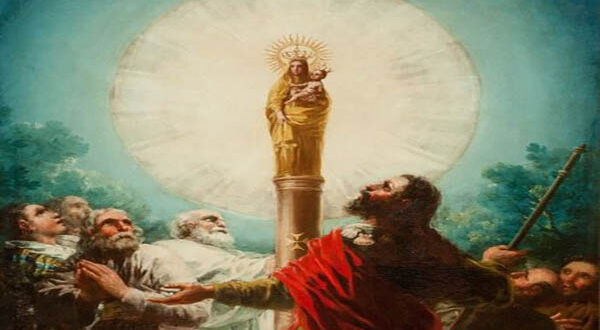
Tradition, supported by an ancient and firm historical and ecclesiastical consensus, takes us back to the night of January 2nd, in the year 40. James, immersed in prayer with his small group of disciples –the Seven Converted Men of Zaragoza– heard something more than the murmur of the wind. Heavenly songs preceded a blinding light that tore through the darkness.
Upon a pillar of marble –a column of jasper said by popular devotion to have been brought by angels– the Blessed Virgin Mary appeared in carne mortal (in mortal flesh). A crucial detail: Mary was still living in Ephesus, in the house we venerate today. Bilocation, the gift of being in two places at once, was the first miracle of this apparition, a sign of God’s power that transcends all space-time limits.
The Virgin, full of consolation and strength, spoke to James with a message of eternal hope:
- “My son James”, she called him, with the tenderness of a mother and the authority of the Queen of the Apostles.
- She entrusted him to build a chapel in her honor on that very spot, next to the Ebro.
- She promised her perpetual protection for that land and for the apostolic work he was doing: “This place will remain until the end of time so that the virtue of God may work wonders and marvels through my intercession for those who in their needs implore my patronage.”
- As tangible proof of her visit and her promise, she left the column, the “Pillar,” upon which she had descended.
This was not an ethereal encounter or a dream. It was a physical, real apparition. The Virgin delivered the Pillar as a legacy, the altar upon which not just a temple would be built, but the faith of a people. And she entrusted James with a task: to commission an artist to create an image of her to be placed on the column. The small wooden carving of Our Lady of the Pillar venerated today is the fruit of that mandate, considered the only image of Mary sculpted during her earthly life.
The First and Greatest Miracle: The Conversion of Hearts
Many think the miracle was only the apparition. But the true, the “first and greatest miracle of the Pillar,” was its immediate fruit: the mass conversion of the people of Zaragoza. James, transformed by the experience, was no longer the discouraged missionary. He was a witness filled with the fire of the Holy Spirit, the same “Son of Thunder” who had walked with Christ.
With the Pillar as irrefutable proof and his faith renewed, James resumed his preaching with an irresistible force. The news of the Marian apparition spread like wildfire through the Caesaraugustan city. The same hearts that were once indifferent or hostile now opened to curiosity, emotion, and finally, to faith. The Apostle’s message, endorsed by the heavenly sign of the Pillar, found an echo. Thousands of people, moved by God’s grace, asked to be baptized.
Tradition speaks of the first eight conversions, the disciples who were with him that night, but the miracle multiplied exponentially. An unprecedented wave of baptisms took place on Hispanic soil. The Ebro River became a western Jordan, where James administered the sacrament to multitudes. This was the great miracle: the transformation of a pagan land into a seedbed of Christians. Our Lady of the Pillar did not come only to console her apostle; she came to be the great missionary and evangelizer of Spain. She planted the seed, and James watered it with his word and his ministry.
The Legacy of James: The Throne of the Rock and the Way
Before returning to Jerusalem, where he would find martyrdom by beheading under Herod Agrippa, James secured the legacy of Zaragoza. The first chapel, a small adobe construction, was erected around the Pillar. It was the first Marian sanctuary, the “throne” the Virgin had chosen. James placed this treasure in the care of the first converts, charging them with its custody and the propagation of its devotion.
His martyrdom did not truncate the mission; it strengthened it. According to legend, his disciples Athanasius and Theodore brought his body back to Hispania, to distant Gallaecia, where it would be discovered centuries later, giving rise to Santiago de Compostela and its Camino (Way).
Here lies one of the most beautiful historical and spiritual curiosities: the Camino de Santiago, in reality, begins in Zaragoza. The Jacobean pilgrimage is not a path of going, but of return. The first pilgrims, even before the discovery of the tomb in Compostela, already came to Zaragoza to honor the place where James received the consolation of the Virgin. The Pillar and Compostela are two poles of the same spiritual axis that runs through Spain. Saint James the Apostle is the bridge between both sanctuaries, the one who received grace on the Ebro and whose body rests in Galicia.
The Apostle’s Mark on Aragonese Culture
The figure of Saint James the Apostle is indelibly engraved on the Aragonese soul. He is not a distant character; he is the “first pilarista” (devotee of the Pillar).
- In Iconography: Inside the Holy Chapel of the Basilica, in the coreto (small choir balcony) surrounding the image of the Virgin, there is a magnificent sculpture of James kneeling, contemplating the Virgin with awe and devotion. It captures the eternal moment of the apparition. Furthermore, the main facade and several reliefs throughout the temple visually narrate this event.
- In the Jota: The Aragonese jota, the song of this land’s soul, has verses dedicated to this moment: “Virgin of the Pillar, / they say that to James / you appeared. / And I say it is true / for you are the Queen / of Aragon / and of the Hispanidad.”
- The Title of “Capital of the Kingdom”: There is a tradition that recounts how the Virgin, during the apparition, promised James that Zaragoza would always be the “capital of the kingdom.” A title historically interpreted in a spiritual sense, but one that the people of Aragon have carried with pride as a sign of a unique destiny.
Conclusion: A Miracle That Endures
The first and greatest miracle of the Pillar was not an isolated event, archived in history books. It is a continuous, living miracle. The jasper column remains in the same place, a silent witness to thousands of pilgrimages, dried tears, fulfilled promises, and faith rekindled for over two thousand years.
Saint James the Apostle teaches us that even in moments of greatest discouragement, when our work seems fruitless, God’s grace can break in in the most unexpected way. His experience in Zaragoza is a message of hope for all: we are not alone in the mission. Mary, our mother, comes to our aid to strengthen us and work, through our fragility, the miracles of conversion that the world needs.
When visiting the Basilica of the Pillar, one does not only encounter an imposing work of art. One kneels before the same pillar that James embraced, one puts oneself in the place of the Apostle who saw the invisible and believed the incredible. It is touching the origin, the first link in a chain of faith, courage, and culture that has forged the identity of Aragon and a large part of the world. James, the first pilgrim, the first devotee, still invites us today to approach that Pillar to receive, like him, consolation, strength, and a mission to fulfill.
