
Related Articles
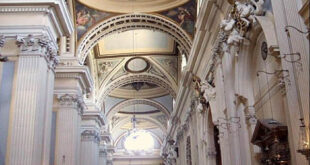
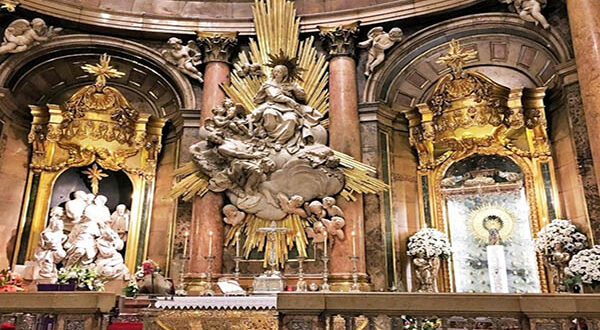
Imagine yourself for a moment in the dim light of an immense basilica. The murmur of prayers is a whisper that rises towards the vaults. Your gaze, like that of thousands of pilgrims before you, is irresistibly drawn to one point: a small temple of marble, jasper, and bronze, glowing under the faint light of countless lamps and candles. It is there, in that space that seems to contain all the light in the world, that the most precious treasure of Aragon and one of the pillars of Christendom is kept: the jasper column –the Pillar– upon which stands the revered image of the Virgin.
This is the Santa Capilla of the Basilica del Pilar in Zaragoza. It is not just a masterpiece of Baroque art; it is the epicenter of a millennia-old tradition, the silent witness to a prodigy that started it all, and the spiritual heart that pumps faith, culture, and identity to an entire people. This article is an invitation to cross its gates and delve into its history, its secrets, and its profound meaning. Prepare for a journey that blends legend with history, art with devotion.
The Origin: A Millennia-Old Tradition that Foundations Faith
To understand the magnitude of the Holy Chapel, we must go back to the origin of everything. Tradition, firmly upheld by the Church, places us on the night of January 2nd, in the year 40 AD. In a Zaragoza then known as Caesaraugusta, the apostle James the Greater, discouraged by the poor reception of his preaching in Roman Hispania, found himself on the banks of the Ebro River.
It was then that he experienced an event that would mark him forever: the Coming of the Virgin Mary in mortal flesh –before her Assumption into Heaven– to comfort him and entrust him with a mission. As testimony of her visit, the Mother of God left a column of jasper –a “pillar”– as a symbol of the unshakable faith he was to establish in those lands, and a small image of herself upon that pillar. This account makes the Virgin del Pilar the first Marian apparition in history, a title that underscores its deep significance.
Upon that very Pillar, James and the first converts built a primitive chapel of adobe. This place, marked by the sacred, would be successively renovated and enlarged over the centuries, but always preserving at its center the same Pillar and the same devotion. The current Holy Chapel is, therefore, the direct heir and custodian of that apostolic heritage.
The Construction of the Baroque Jewel: A Tribute in Marble and Bronze
For centuries, the Pillar and the image of the Virgin were sheltered in different chapels within the church that preceded the current basilica. It wasn’t until the 17th century that the decision was made to build a space worthy of its importance. The definitive impulse came from an extraordinary event: the Miracle of Calanda.
In 1640, a young peasant named Miguel Juan Pellicer, who had had a leg amputated, was visited by the Virgin del Pilar, who miraculously restored his limb. This event, investigated and officially declared a miracle by civil and ecclesiastical authorities, shocked the Spain of the time and ignited devotion to unprecedented levels. Donations began to flow, making the dream of a new and splendid chapel a reality.
The design fell to the royal architect Ventura Rodríguez, who in 1750 presented a project that would forever change the interior appearance of the temple. Ventura Rodríguez conceived the Holy Chapel not as a simple renovation, but as a temple within the temple, an independent Baroque jewel that would house the relic. His genius lay in integrating it into the basilica in such a way that, while part of a whole, it stood out with its own personality.
The Artists Who Gave Shape to a Dream
Ventura Rodríguez coordinated a dream team of first-rate artists:
- The brothers José and Manuel Ramírez de Arellano: Sculptors of the spectacular elliptical vault that crowns the chapel, decorated with rocaille, garlands, and cherubs (putti) that seem to float in the sky. Their work in stucco is of overwhelming delicacy and movement.
- Damián Forment (in a prior work) and José Ramírez de Arellano: responsible for the main alabaster altarpiece that precedes the camarín (small chamber), depicting the Coming of the Virgin.
- The sculptors of the Holy Image: The Gothic carving of the Virgin we venerate today, 36 cm tall, was made by Juan de la Huerta in the 15th century, replacing an earlier one. The crown and robes (the famous “mantos”) are later additions of incalculable value.
- The silversmiths and blacksmiths: Those who forged the monumental wrought-iron grille that surrounds the chapel, a work of art in iron that protects without hiding, allowing the faithful to completely surround the sacred place.
The chosen materials, marble of different colors, jaspers, and bronzes, create a chromatic play of light and shadow that directs all attention to the center: the Sacred Pillar and the image of the Virgin.
A Tour of its Symbolism and Key Elements
Every centimeter of the Holy Chapel is loaded with meaning. It is not whimsical decoration; it is a visual narrative of faith.
- The Perfect Oval: The oval floor plan of the chapel is not accidental. The oval, a quintessential Baroque symbol, represents the cosmic egg, the origin of life, divine perfection. It envelops you, includes you in the scene, making the faithful participant in the mystery they contemplate.
- The Camarín of the Virgin: This is the sanctum sanctorum, the most intimate place. Surrounding the Pillar, pilgrims can approach to touch it (through a silver oval in the mantle) and pass behind the image, a ritual that symbolizes “accompanying” the Virgin.
- The Jasper Column (The Pillar): It measures 1.77 meters in height and has a diameter of 24 centimeters. Always covered by a silver cylinder and the Virgin’s mantle (except on rare occasions: the 2nd, 12th, and 20th of each month, when it is shown uncovered), it is the physical object that connects directly to the original miracle. To touch it is to touch the living history of faith.
- The Virgin’s Mantle: The Virgin del Pilar is probably the most “dressed” Marian image in the world. She possesses more than 450 different mantles, which are changed according to the liturgical calendar and festivities. This act of dressing the Virgin is a unique show of popular affection and devotion.
- The Word “ARAGÓN”: A curious and little-known detail. If you observe the rocaille decoration on the vault carefully, among its abstract shapes, you can clearly read the word “ARAGÓN”! A wink from the artists to the land that guards this treasure.
The Holy Chapel Today: Center of Pilgrimage and Living Culture
The Holy Chapel is not a museum. It is a vibrant, living place of worship. It is the final destination for millions of pilgrims each year, who arrive from all corners of the world. It is a witness to massive venerations (besapiés), constant masses, silent prayers, and fulfilled promises.
It is also the soul of the Fiestas del Pilar in Zaragoza, when the Offering of Flowers fills the square with color and scent, and each of those bouquets is, in reality, a tribute directed towards that small sacred space.
But its influence transcends the religious. The Holy Chapel is a symbol of identity for all Aragonese, believers or not. It is the mark of a people, their history carved in marble, their resilience and their character. It has inspired painters like Goya, writers, musicians, and generations of Zaragozans who, simply passing through the square, feel the tranquility of knowing that there, in the heart of their city, dwells a presence that protects and accompanies them.
Tips for Visiting and Experiencing It
If you are going to visit the Holy Chapel, do so calmly. Don’t be just another tourist; be a pilgrim, even if only for a few minutes.
- Walk around it: Walk slowly around its grille. Observe the details from all angles.
- Approach the silver oval: Wait your turn, touch the Pillar through it. It is a moment for a prayer, a wish, or a simple “thank you.”
- Pass behind: Don’t just stay in front of her. The complete ritual involves passing behind, a gesture of closeness and companionship.
- Look up: Let your gaze rise to the elliptical dome. Let the Baroque art elevate your spirit.
- Attend a mass: Even if only for a few minutes. Hearing the liturgy in that space gives it a completely new dimension.
- Visit the Pilarista Museum: There you can see many of the Virgin’s mantles, the collection of jewels, and other objects donated over the centuries, which complete the history.
Conclusion: More Than Marble, an Eternal Symbol
The Holy Chapel of the Pillar is, ultimately, the materialization of an unshakable faith. It is the result of centuries of love, belief, art, and history condensed into a space of breathtaking beauty. It is not just the place that guards a jasper column; it is the symbol that, upon the simplest and purest faith, something eternal and magnificent can be built.
It is the legacy of James, the genius of Ventura Rodríguez, the devotion of a people, and the love of a Mother who, according to tradition, wished to remain among us forever. In Zaragoza, the heart does not beat in the chest; it beats in the Holy Chapel of the Pillar. Come and feel it.
