
Related Articles
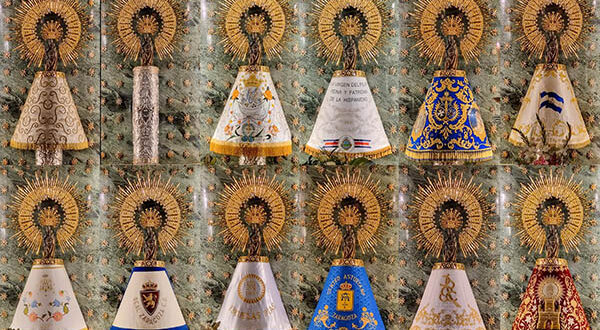
Every day, those who come to the Basilica of Our Lady of the Pillar in Zaragoza witness a gesture full of symbolism: the Virgin appears clothed in one of the hundreds of mantles that, over the centuries, have been offered to her as a sign of love and gratitude. This is not a simple ornament, but a silent language of faith that has become a living tradition.
Today, Our Lady of the Pillar safeguards more than 450 mantles, carefully preserved in the Sacristy and the Pilarist Museum. Many children of Zaragoza, before receiving their First Communion, joyfully live the ritual of “passing under the mantle,” as a sign of protection and closeness to the Mother of God.
A Tradition Rooted in Centuries Past
Documents from the 16th century already mention this custom. In 1577, 72 mantles were catalogued, and since then, the collection has continued to grow. In earlier times, these mantles were placed as full garments that covered almost the entire image, leaving only the faces of the Virgin and the Child visible.
With the reform led in the 18th century by architect Ventura Rodríguez, the mantle began to be placed lower, at the level of the column, so that the Gothic statue of the Virgin would remain uncovered. Thus arose the arrangement we know today: a trapezoidal skirt-shaped mantle that dresses the Pillar itself, while the image remains visible.
Colors that Follow the Rhythm of the Liturgy
The mantles are not chosen at random. The Church establishes that their color must correspond to the liturgical season:
- White: for Easter, solemnities, and feasts of the Lord.
- Green: Ordinary Time.
- Purple: Advent, Lent, and days of the faithful departed.
- Red: in memory of the martyrs.
- Blue: Marian feasts, such as the Novena of the Immaculate Conception.
In addition, on special days, particular mantles are placed: the mantle of the Carmelites on July 16, that of the Civil Guard on its feast day, or the one donated by Queen María Cristina when the Royal Family visits the Basilica. There are even days when the Virgin appears without a mantle —on the 2nd, 12th, and 20th of each month— as a remembrance of her coming to Zaragoza, her principal feast, and the canonical coronation of her image.
Gifts Born of Devotion
The mantles are offerings donated by families, institutions, confraternities, schools, nations, bullfighters, artisans, and even the media, such as the Heraldo de Aragón, which presented a mantle as a sign of its pilarist devotion. Each piece carries a story: an act of thanksgiving, a plea for help, a tribute, or simply a gesture of filial love toward the Virgin Mary.
They are crafted from a wide variety of materials —velvet, silk, tissue, damask, brocades, even leather or paper— and embroidered using techniques ranging from lace and crochet to gemstones and enamels. Some of them are true works of art, but they go beyond the material dimension, for they are offerings that speak of faith.
The Ritual of Changing the Mantle
Each night, when the Basilica closes, the chaplain of the Virgin enters the chamber to carry out a discreet yet meaningful action: removing the mantle of the day and placing the one for the following day. He uses a frame known as the “portamantos,” which allows the mantle to be carefully adjusted to the Pillar. Then, the doors are closed, and the Virgin remains hidden until the next morning, when she is once again revealed to the faithful.
Beneath the Mantle of the Virgin: A Sign of Protection
For centuries, many of these mantles have been lent to the sick, accompanying them in their suffering, fulfilling what we pray in the litanies: “Health of the sick, pray for us.” It was customary to spread the mantles over those who were ill, as a token of consolation and hope. From this practice comes the well-known phrase often seen in Aragonese obituaries: “He (or she) died under the mantle of Our Lady of the Pillar.”
In more recent times, due to the great demand, the so-called “measures of the Virgin” were introduced: fabric ribbons in as many colors as the mantles themselves, reproducing the exact size of the image. These ribbons allow the faithful to carry with them, at home or even in their cars, a tangible reminder of the maternal protection of Mary.
A Collection that is a Spiritual Heritage
Today, Our Lady of the Pillar possesses more than 450 mantles, each one unique, yet all bearing witness to the same reality: the simple yet profound faith of a people who know themselves sheltered by their Mother. Anyone who contemplates the Virgin clothed in these garments quickly realizes that they are not mere decorations, but living symbols of the history of love between Zaragoza, Aragón, Spain, Latin America, and Mary of the Pillar.
For every embroidered thread, every liturgical color, every offering entrusted in the Basilica recalls the promise that sustains the faith of generations:
“Do not be afraid, my child, for I will always be with you.”
