
Related Articles
Every year, in the crucible of October, Zaragoza ceases to be simply a city and transforms into a heartbeat. A collective, pulsating, and emotional heartbeat that materializes into a human river of countless colors. This river, winding and perfumed, flows with millennial devotion towards the same sea: the Basilica of Our Lady of the Pillar. It is the Offering of Flowers, the central act of the Fiestas del Pilar and, without a doubt, one of the most moving and beautiful spectacles of faith and folklore in the world. It is not just a tradition; it is a poem written with petals, a symphony performed with silences laden with emotion and Aragonese songs, a collective promise renewed from the heart of a people.
Beyond the impressive carpet of flowers that weaves the Virgin’s mantle, this event is a sensory and spiritual journey. It is the essence of Aragon, with its culture, its character both sturdy and tender, and its unshakable faith, standing tall and parading with pride. This article is a guide for the soul, an invitation to understand not only the what but the why. To immerse yourself in the history, symbolism, and emotions that make the Offering a unique phenomenon.
A Tradition with Modern Roots: The Origin of the Offering
It is curious that an act so deeply felt and ancestral in its spirit has a relatively recent origin. Unlike the veneration of the Virgin, which tradition dates back to the dawn of Christianity in Hispania, the Offering of Flowers as we know it was born in 1958.
The Spanish post-war period was a difficult time, but by the 1950s, a desire emerged to revitalize the festivals, to endow them with a splendor and popular participation that would consolidate them. It was the idea of a group of prominent Zaragozans, led by the then mayor Luis Gómez Laguna, to create an act that would symbolize in the most visual and beautiful way possible the devotion of a people towards their Patroness.
The first Offering took place on October 12, 1958. That year, some 7,000 people paraded before the Virgin. A modest number compared to the hundreds of thousands today, but it laid the foundation for everything. The success was immediate. The image of the Virgin receiving those first flowers resonated deeply in the collective imagination. A tradition had not been invented; the perfect way to express one that had existed for centuries in the hearts of the Aragonese people had been found.
The Symbolism of an Act of Love: What Does the Offering Mean?
The Offering of Flowers is an act laden with deep Christian and human symbolism:
- The Flower as a Symbol of Purity and Ephemeral Beauty: In Christian language, flowers represent purity, the beauty of creation, and virtue. By offering a flower, the devotee offers the beautiful and pure aspects of their own life. Furthermore, their fleeting nature – they wither quickly – is a reminder of humility and the brevity of earthly life, which is offered up to the eternal.
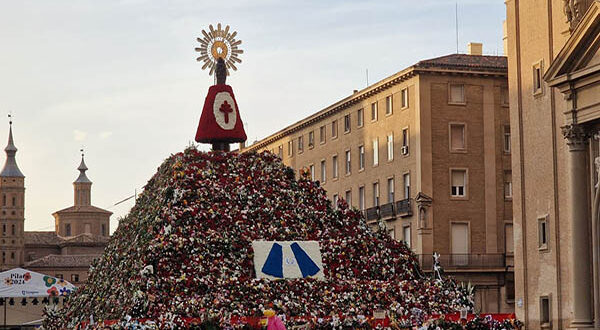
- The Mantle of the Virgin: The accumulation of thousands of carnations, roses, gladioli, and chrysanthemums gradually weaves, before everyone’s eyes, a gigantic and colorful mantle for the image of the Virgin. This mantle symbolizes the protection, shelter, and love of an entire people for their Mother. It is the way to “clothe her” with the affection of her children.
- The Act of Offering: At its core, the flower is a vehicle. What is truly offered is oneself. It is gratitude for a granted favor, a request for help in a difficult time, a promise of fidelity, or simply the expression of a filial love that needs no words. Each person who deposits their flower is leaving a part of their personal story there.
A Human River that Floods the City: Experien the Day of the Offering
On the day of the Offering, normally the afternoon of October 12th, Zaragoza comes to a standstill. The emotion is tangible in the air. The sound of thousands of bass drums and Aragonese “gaita de boto” drums reverberates in your chest. The smell of carnations and the sugar from “frutas de Aragón” (candied fruits) permeates everything.
The parade is a vibrant mosaic of society:
- The Peñas (Social Clubs): They are the soul of the festival. Their members, dressed in the traditional Aragonese costume or with vibrant shirts, parade with allegorical floats and huge floral arrangements, animating the path with songs and jotas. Their energy is contagious.
- Institutions and Authorities: From the King to representatives of all public institutions, they pay their official homage.
- The Common People: Here lies the true essence. Entire families, groups of friends, children in their best clothes, elderly people who may no longer be able to walk but are pushed in wheelchairs with a trembling flower in their hand… everyone is a protagonist. It is profoundly moving to see a grandmother in her black dress, paring with immense dignity, or a child looking with amazed eyes at the spectacle they will one day continue.
The route advances slowly along the Coso Boulevard until reaching the Plaza del Pilar. The wait can be hours long, but it doesn’t matter. It is a time for fellowship, for patience, and for anticipation. The culmination comes when climbing the steps of the Basilica. It is the intimate moment within the immensity. There, before the Holy Chapel, volunteers collect the flowers from the offerers. It is an instant charged with emotion: a glance towards the image of the Virgin, a whispered prayer, a furtive tear… and the flower that is deposited, adding to the mountain that grows ceaselessly.
Curiosities and Secrets of the Flower Carpet
Behind this ephemeral work of art lies a titanic and detailed effort:
- The Logistics are Colossal: It is estimated that around 10 million flowers are offered, weighing over 40 tons. Everything must be meticulously organized.
- The “Picaos” (The Stabbers): They are the anonymous artists. An army of nearly 400 volunteers (florists, students, everyday citizens) work against the clock, taking shifts throughout the night and the next day, to meticulously stick each flower into a sponge structure that has been pre-drawn with the mantle’s design. They work in exhausting shifts, motivated solely by devotion.
- Designs with Meaning: The mantle is not random. Each year it has a different design, often related to a specific theme: an anniversary, an aspect of the faith, an Aragonese symbol… Before the Offering, the design is kept secret to surprise everyone.
- A Guinness World Record: In 2009, the Offering of Flowers was recognized by Guinness World Records as the largest floral offering in the world, a title it reclaims each year with gusto.
- The Fate of the Flowers: What happens to so many flowers once the festivals are over? Nothing is wasted. The flowers are removed and composted, turning into natural fertilizer, thus closing a cycle of life and symbolism in an ecological and respectful way.
Beyond the Flower: The Offering of Fruits
The day after the Offering of Flowers, its sister act takes place: the Offering of Fruits. If the flowers represent beauty and devotion, the fruits symbolize gratitude, the harvest, and the work of the land. It is a tribute to the agricultural tradition of Aragon and the products of its land.
Decorated carts parade and the best fruits of the Aragonese orchard are offered to the Virgin: enormous pumpkins, clusters of grapes, baskets of peaches, wineskins of wine, hams, cheeses, longanizas sausages, artisanally baked breads… It is an explosion of autumn and abundance, a show of gratitude for the food received and a petition for future harvests. Together, the Offering of Flowers and the Offering of Fruits represent total giving: the beautiful and the productive, the soul and the sustenance.
A Pilgrim’s Experience: How to Experience the Offering Live
If you are thinking of experiencing it, here is some advice:
- Arrive Early: Choose a point along the route and be there hours before. People start securing spots first thing in the morning.
- Soak Up the Atmosphere: Don’t stay still. Walk along the route, feel the energy of the peñas, listen to the jotas, let yourself go.
- Go to the Steps: If you can, make it to the base of the Basilica. Seeing the faces of the offerers up close at the culminating moment is an unforgettable experience.
- Respect the Moment: Although it is a festival, at the moment of the offering there is a deep respect and reverence. Be part of that silent emotion.
- Return the Next Day: Essential. Seeing the completed mantle in the daylight in all its magnificence, and attending the Offering of Fruits, completes the experience.
Conclusion: An Enduring Heartbeat
The Offering of Flowers to the Virgin of the Pillar is not just for believers. It is a cultural, human, and artistic phenomenon of the first order. It is watching an entire city come together to create, among everyone, a living work of art that will last barely a day, but whose memory endures forever in the heart.
It is the spirit of Aragon made color. It is faith transformed into scent. It is proof that, sometimes, the most ephemeral things leave the most permanent mark. It is, ultimately, a universal reminder that beauty, community, and sincere devotion have the power to transform the world, at least for one day, into a more hopeful and colorful place.
Would you like to be part of this river? The Virgin of the Pillar and Zaragoza await you with open arms, and open petals.
